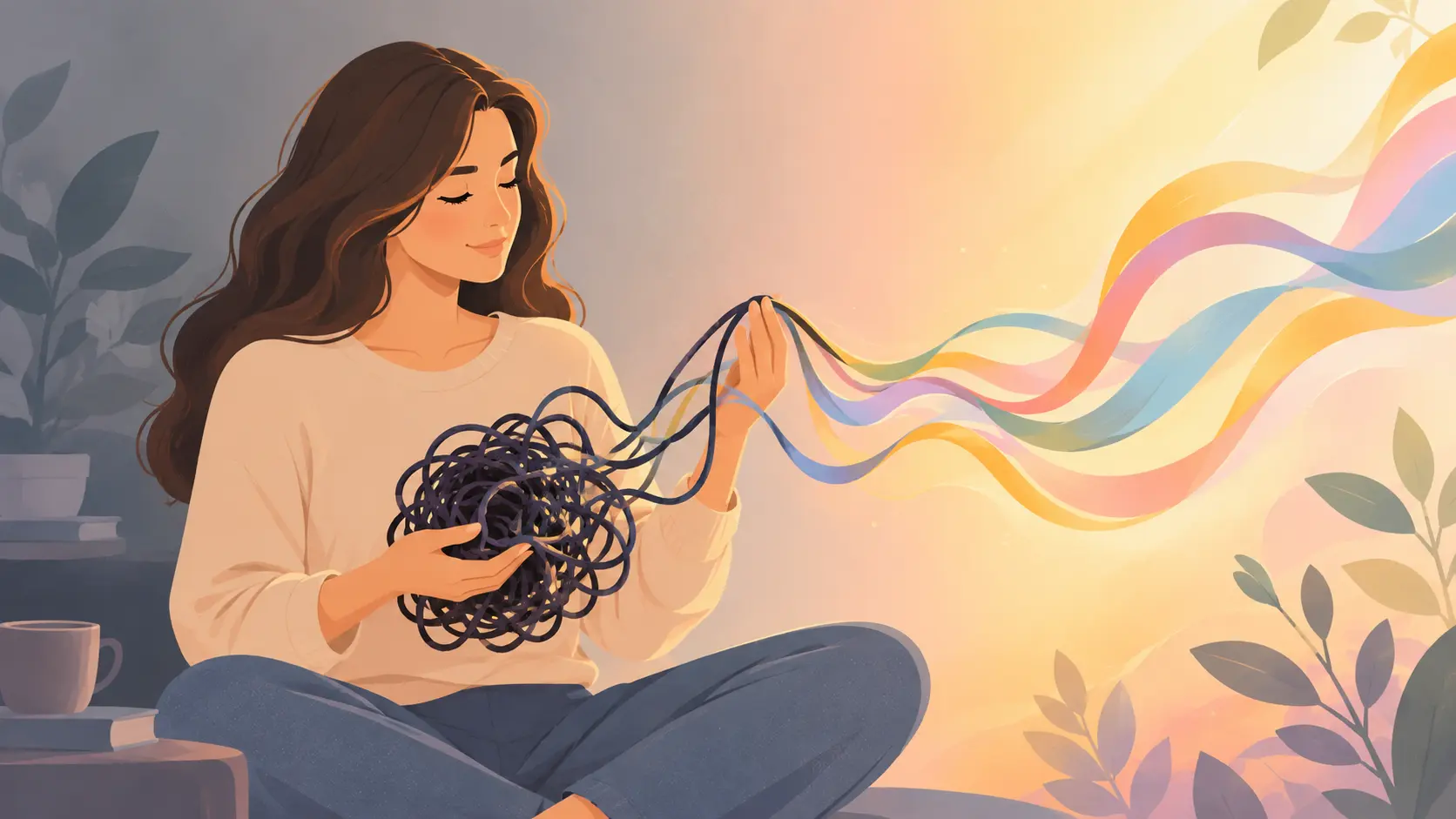
So often, when asked "what do you want most in life?", the answer comes almost instantly: to be happy!
We live immersed in a culture that celebrates the idea of constant happiness. Between carefully curated feeds, simplistic motivational quotes and the subtle pressure to "stay focused on the positive", we grow used to seeing emotional discomfort as a personal failure or weakness — to treating sadness, fear or anger as fires that must be put out in a hurry, pushing what hurts into the darkest corner of the mind.
But the truth is that we were not designed for numbness. The fact that an emotion is uncomfortable does not mean it is a mistake; most of the time, it is simply our body's visceral language trying to protect us and to signal the state of our deepest psychological needs.
The truth is that "the pain we refuse to feel hurts the most" — because when we refuse to live through the legitimate pain of a loss or a change, we open the door to accumulated, silent suffering. Grief is to loss what laughter is to joy: depriving ourselves of discomfort in the face of what hurts us is like depriving the body of the ability to feel physical pain when it is injured.
Feeling about what we feel: the real exhaustion
What wears us out day to day is rarely the initial emotion. The real exhaustion comes from the second layer we build on top of it: judgement. We start to feel about what we feel.
We feel sad about a loss, but straight away we feel guilty for being sad; we feel afraid of a situation, but then we become sad or angry with ourselves for feeling afraid. And when our mind takes that primary emotion of fear and projects it onto the uncertainty of tomorrow, trying to predict and control scenarios that have not yet happened, anxiety appears. We become trapped in an exhausting inner dialogue, trying to solve in our heads what can only be held in the body.
The myth of "Zero Anxiety" in therapy
That is why, when clients tell me "Oriana, my goal for therapy is to stop having anxiety", my answer is very clear: that is not what will happen in our sessions, because we are not supposed to be free of anxiety.
Having zero anxiety would be as dangerous as — or even more dangerous than — living in a constant state of alarm. If our anxiety were nil, we would lose our inner self-preservation alarm — the one that makes us look both ways before crossing the road, prepare for an important commitment or protect the people we love. The aim of the therapeutic process is not to eradicate anxiety or turn life into a display of unshakeable strength, but to learn to keep it at the right dose, so that it protects us without paralysing us.
Lightening the tone to see the colours again
This is not about "sugar-coating the pill" or forcing a naive positivity. When sadness sets in, it is natural to wear "glasses that turn reality grey" — that tone is simply an honest reflection of what we are going through. The invitation of emotional regulation is not to paint reality in false colours, but to gradually lighten that grey, making room so that, at your own pace, you can once again see the full palette of life's colours.
Being an emotionally regulated adult does not mean no longer feeling discomfort or living in a state of unchanging serenity. It means, above all, learning not to act on autopilot in the face of discomfort. It means being able to drive your own life and seat the emotion in the passenger seat... acknowledging its presence, listening to what it has come to teach us, but without handing it the wheel.
Regulating emotions is not about blocking them or forcing ourselves to feel only what is pleasant. In therapy, we make room for these emotions: we learn to recognise them, to understand when they arise and what for — dismantling the layers of guilt or fear so that you can regain your autonomy and well-being.